
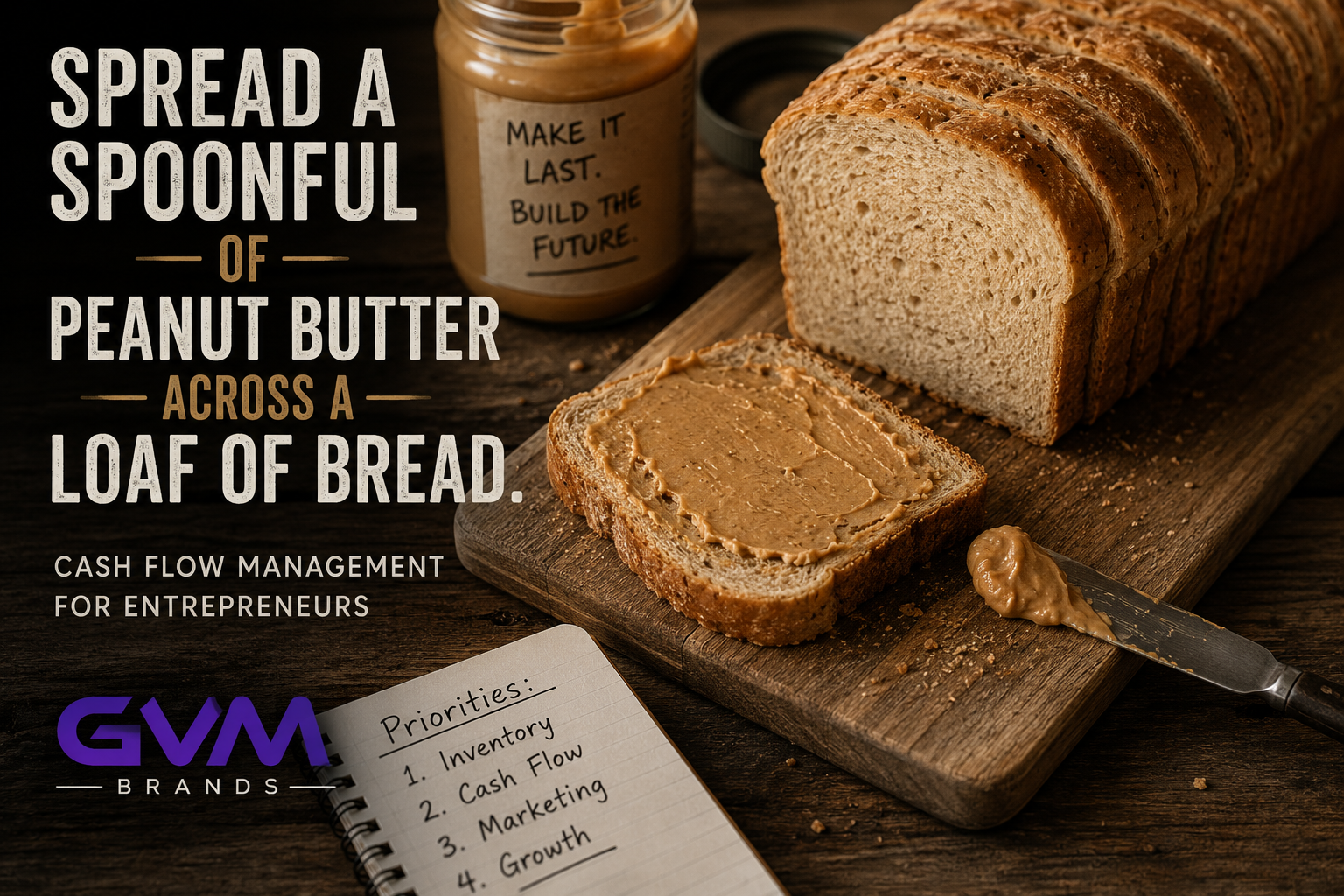
Spreading Peanut Butter Across a Loaf of Bread
There is a phrase I’ve carried with me most of my life:
“Spread a spoonful of peanut butter across a loaf of bread.”
Growing up without much, you learn quickly that resources are limited. Whether it’s money, food, time, or opportunity, you don’t always have enough of what you need. The people who survive learn how to stretch what they have further than anyone thinks possible.
Over the years, I’ve realized that entrepreneurship is no different.
Most startups begin with a dream, a product, and a limited amount of money. The challenge isn’t simply making money. The challenge is making the money you have last long enough to build momentum.
That’s where many entrepreneurs make their first mistake.
When cash finally shows up, they spend it.
A new logo.
A fancy website.
An expensive trade show booth.
A bigger office.
Equipment they don’t really need.
Inventory that sits on shelves.
None of these purchases are necessarily bad. The problem is making them too early.
Every dollar spent today is a dollar that can’t be spent tomorrow.
When you’re building a business, momentum is everything. A bad purchase doesn’t just cost the money you spent. It costs the opportunities that money could have created.
I’ve seen businesses run out of cash chasing appearances instead of results.
I’ve also seen entrepreneurs with very little capital build incredible companies because they understood one thing:
Protect the momentum.
At GVM Brands, we’ve learned that growth rarely happens in a straight line. Sometimes opportunities arrive faster than cash flow. Inventory has to be purchased before it’s sold. Marketing expenses show up before the sales do. New products require investment before they generate revenue.
That’s where discipline becomes a competitive advantage.
Tools like Affirm, Sezzle, Klarna, vendor terms, business credit, and deferred payment programs can be valuable when used correctly. Not because they allow you to buy things you can’t afford, but because they allow you to preserve cash for opportunities that generate returns.
There’s a big difference between productive debt and destructive debt.
Productive debt creates revenue.
Destructive debt creates stress.
The question every entrepreneur should ask before spending money is simple:
Will this decision create momentum or kill momentum?
If the answer is momentum, it may be worth the investment.
If the answer is ego, convenience, or impatience, it probably isn’t.
The truth is that most successful entrepreneurs aren’t the smartest people in the room. They aren’t always the most talented. They aren’t always the best funded.
They simply learn how to allocate resources better than everyone else.
They understand that every dollar has a job.
Every hour has a purpose.
Every decision has a cost.
In business, just like in life, you don’t always get more peanut butter.
Sometimes all you get is the spoonful you already have.
The people who win aren’t necessarily the ones with the most resources.
They’re the ones who know how to spread them across the entire loaf.